
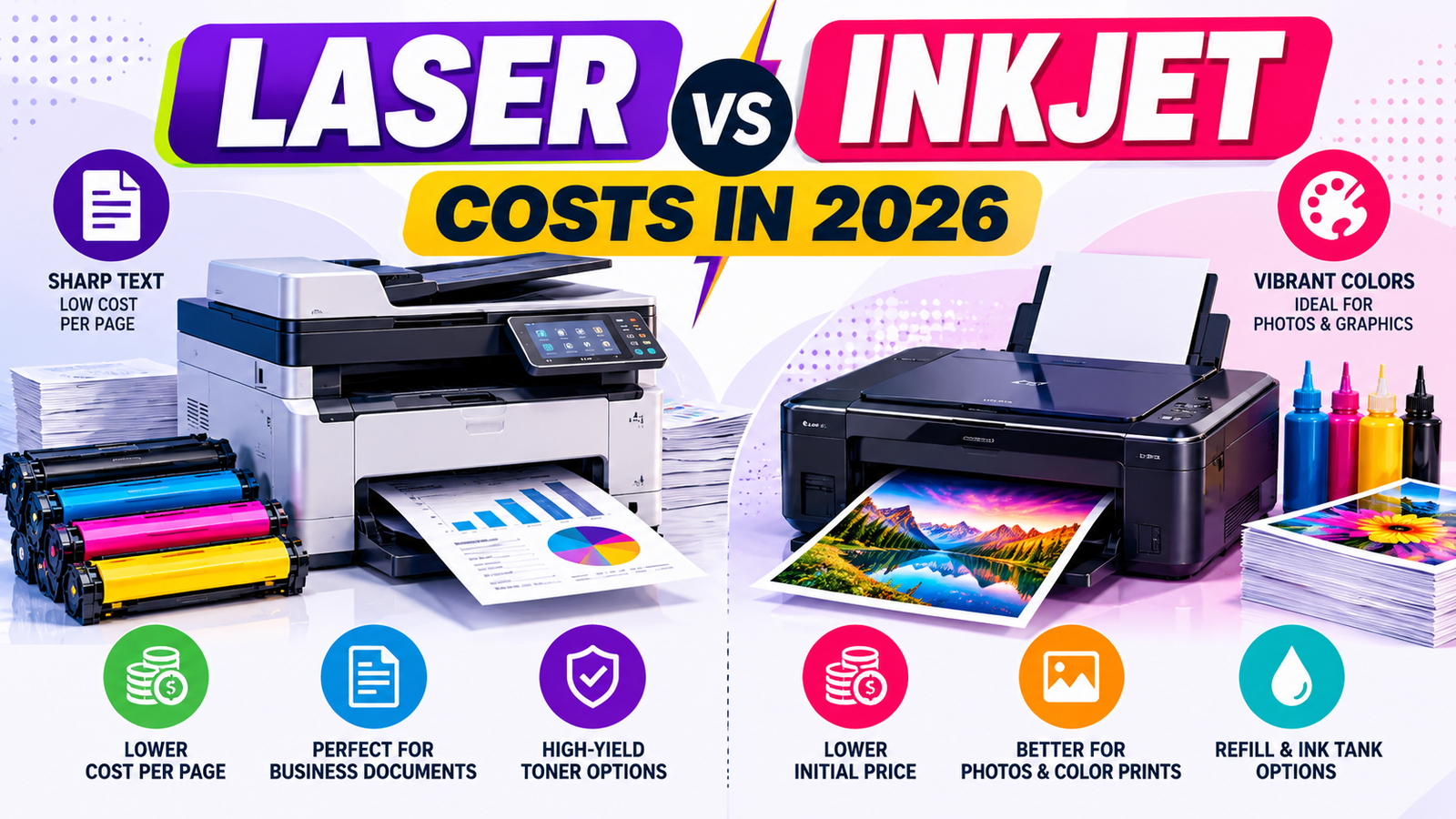
Color laser vs inkjet printer cost is one of the most important factors to consider when buying a printer in 2026. A printer with an affordable purchase price may become expensive after several months of replacing ink cartridges, while a more expensive printer can sometimes save money through lower long-term printing expenses.
For small businesses, home offices, students, and professionals, choosing between a laser printer and an inkjet printer involves more than comparing prices. Printing speed, document quality, ink and toner replacement, maintenance, and expected printing volume all influence the final cost.
The decision has also become more complicated because modern inkjet printers include both traditional cartridge systems and refillable ink tank technology. These machines can have very different running costs, even though they use similar printing principles.
This 2026 guide compares actual U.S. printer prices, explains ink and toner expenses, and provides practical three-year cost examples. It will help you understand which technology offers better value for your printing needs.
Color Laser vs Inkjet Printer Cost: Key Differences in 2026
Laser and inkjet printers use different technologies to transfer text and images onto paper.
Laser printers use powdered toner and a controlled imaging process. Most office laser printers use heat and pressure to permanently bond the toner to the paper.
Inkjet printers place tiny droplets of liquid ink onto paper. Different ink formulations and printhead technologies influence the resulting text, graphics, and photographs.
Both technologies are widely used for office work, but their strengths differ.
How Color Laser Printers Work
A color laser printer typically uses four toner colors: cyan, magenta, yellow, and black.
These colors combine to create business charts, presentations, reports, and other documents.
Laser printers are often valued for sharp text, quick multipage document production, and consistent output.
They can be particularly useful when employees print invoices, contracts, spreadsheets, and marketing reports throughout the day.
However, color toner cartridges can be expensive, and some models require additional maintenance components.
How Inkjet Printers Work
Inkjet printers use liquid ink delivered through a printhead.
Many models produce detailed photographs, colorful graphics, and attractive presentations.
Traditional inkjet printers usually rely on replaceable cartridges. Ink tank printers instead store larger quantities of ink in refillable reservoirs.
The distinction is important because a cartridge inkjet and an ink tank printer can have very different operating expenses.
For a fair comparison, buyers should consider three categories: cartridge inkjet, refillable ink tank, and color laser printing.
Color Laser vs Inkjet Printer Prices in 2026
Printer purchase prices vary according to functionality, brand, paper capacity, and printing technology.
A basic printer designed for occasional household printing may cost less than a multifunction machine with automatic document scanning and advanced networking.
The following examples show manufacturer-listed U.S. prices and specifications checked in October 2026.
| Printer model | Technology | Listed U.S. price | Notable features |
|---|---|---|---|
| Brother HL-L3280CDW | Digital color LED, laser-quality output | $344.99 | Wireless, duplex, up to 27 ppm |
| Epson EcoTank ET-3950 | Refillable ink tank | $399.99 | Print, scan, copy, automatic document feeder |
| Epson EcoTank ET-4950 | Refillable ink tank | $499.99 | Print, scan, copy, fax, touchscreen |
Prices are manufacturer reference prices, not guaranteed transaction prices. Promotions, stock availability, and local taxes can change the amount paid.
These models are not identical in functionality. The Brother HL-L3280CDW is primarily a print-only machine, while the Epson devices provide additional scanning and copying capabilities.
That difference matters because paying more for an all-in-one device can eliminate the need to purchase a separate scanner.
The lowest purchase price does not necessarily produce the lowest total ownership cost.
Laser vs Inkjet Cost Per Page: How to Calculate It
Cost per page describes the approximate expense of ink or toner required to print one page.
It is one of the most useful measurements when comparing printers for regular business use.
The basic formula is:
Cost per page = Consumable price ÷ Estimated page yield
Suppose a black toner cartridge costs $90 and has a rated yield of 3,000 pages.
The estimated black toner expense is:
$90 ÷ 3,000 = $0.03 per page.
Now consider an ink cartridge costing $35 with an estimated yield of 700 pages.
The ink expense becomes:
$35 ÷ 700 = $0.05 per page.
In these hypothetical examples, the laser printer uses less expensive supplies per black-and-white page.
However, this does not prove that every laser printer is cheaper. Some modern ink tank systems have substantially lower ink expenses.
Why Color Printing Costs More
Color printing usually requires multiple consumables.
For a color laser printer, a fully colored page may consume cyan, magenta, yellow, and black toner.
A useful estimation method is to add the cost-per-page contributions of the relevant cartridges using their published yields.
For example, if the estimated contribution from black toner is three cents and each of three color cartridges contributes four cents, the combined consumable cost would be approximately fifteen cents per standardized color page.
Actual printing costs vary with image coverage, document design, and printer behavior.
For inkjet printers, the same principle applies: all ink colors contributing to the printed document should be considered.
What Do ISO Page-Yield Standards Mean?
Printer manufacturers commonly use standardized testing methods to estimate how many pages a cartridge can print.
ISO/IEC 24711:2021 covers cartridge yield testing for color inkjet printers, while ISO/IEC 19798:2025 addresses color toner cartridge yields.
These standards help buyers compare supplies under defined testing conditions.
They do not guarantee that every customer will achieve the same page count.
Printing photographs, full-page backgrounds, and large graphics can use significantly more ink or toner than typical test documents.
Toner Replacement Costs for Color Laser Printers
Replacement toner is often the largest ongoing consumable expense for a color laser printer.
A typical color system uses four cartridges, and each may have a different replacement schedule.
The Brother HL-L3280CDW, for example, supports TN229-series toner cartridges. Brother lists high-yield TN229XL black toner at approximately 3,000 pages and high-yield cyan, magenta, and yellow cartridges at approximately 2,300 pages each.
These are manufacturer-rated yields rather than guaranteed results.
The printer also uses a drum unit, making it important to consider equipment maintenance beyond ordinary toner replacement.
Before purchasing a color laser printer, examine replacement cartridge prices, available high-yield options, and expected maintenance component life.
Buying an inexpensive printer that requires costly replacement supplies may not be the best long-term decision.
Inkjet Cartridge Costs vs Refillable Ink Tanks
Not all inkjet printers are expensive to operate.
Traditional cartridge printers often have an affordable initial purchase price, but users may need regular cartridge replacements.
A household printing only a few documents each week may find this acceptable.
Businesses printing hundreds of color pages monthly should also consider refillable ink tank models.
For example, Epson advertises that the EcoTank ET-3950 includes enough ink for up to 6,600 black pages or 5,500 color pages under specified testing conditions.
Actual output depends on printing habits, maintenance, and document coverage.
The included ink can be financially valuable because customers may not need to purchase their first replacement bottles immediately.
However, ink tank printers still require proper maintenance. Printheads can experience nozzle problems, and some machines use replaceable maintenance boxes.
The best operating-cost comparison includes these potential expenses.
Color Laser vs Inkjet Printer Cost: Three-Year Ownership Comparison
Understanding color laser vs inkjet printer cost over three years can help home users and small businesses avoid unnecessary expenses. While laser printers may offer competitive toner costs for business documents, modern ink tank printers can provide significant savings for frequent color printing. The right choice depends on purchase price, printing volume, replacement supplies, and maintenance requirements.
A three-year calculation demonstrates why the purchase price alone is misleading.
Consider a fictional U.S. small business printing 300 pages per month.
Approximately 60% of its documents are black-and-white, and 40% are color.
Over 36 months, the business prints 10,800 pages, including 6,480 black pages and 4,320 color pages.
For illustration, assume three printing systems have the following purchase prices and consumable rates.
| Cost factor | Cartridge inkjet | Color laser | Ink tank |
|---|---|---|---|
| Printer purchase | $179 | $345 | $400 |
| Black consumables/page | $0.045 | $0.035 | $0.007 |
| Color consumables/page | $0.170 | $0.140 | $0.012 |
| Monthly consumables | $28.50 | $23.10 | $2.70 |
| 36-month consumables | $1,026.00 | $831.60 | $97.20 |
| Purchase + consumables | $1,205.00 | $1,176.60 | $497.20 |
Important: All consumable rates and the $179 cartridge-inkjet price are hypothetical assumptions for this comparison. The laser and tank purchase amounts are rounded reference figures. This simplified model ignores included starter ink or toner, paper, electricity, maintenance, taxes, and residual value; it is not a prediction of actual ownership costs for specific models.
Under these assumptions, the refillable ink tank system offers the lowest calculated expense.
The color laser printer costs slightly less than the conventional cartridge inkjet over three years, despite having a higher initial price.
Changing the print volume or consumable rates could produce a different result.
The lesson is to calculate expenses using the actual replacement supplies for the specific printer being considered.
When Does a More Expensive Printer Pay for Itself?
A higher purchase price can sometimes be recovered through lower printing expenses.
This is commonly called the break-even point.
To estimate it, subtract the less expensive printer’s purchase price from the more expensive printer’s purchase price.
Then divide that difference by the expected savings per printed page.
For example, suppose an ink tank printer costs $150 more than a competing model but saves five cents in consumables per printed page.
The estimated break-even volume is:
$150 ÷ $0.05 = 3,000 pages.
At 100 pages per month, reaching that volume takes approximately 30 months.
At 500 pages per month, it takes around six months.
This simplified calculation does not account for included starter ink, maintenance, or equipment reliability. Nevertheless, it demonstrates why printing volume is central to the purchasing decision.
Which Printer Is Better for Small Business Documents?
Color laser printers are often practical for businesses producing large quantities of ordinary office documents.
An accounting office may print contracts, financial statements, customer invoices, and internal reports every day.
For this workload, reliable paper handling, crisp text, and consistent printing speed are particularly valuable.
A color laser printer can also be convenient when the machine remains unused for several days because toner does not dry out like liquid ink.
However, businesses producing brochures, colorful presentations, or image-heavy documents should carefully compare actual output samples.
Some inkjet printers can produce more attractive photographic results, particularly on appropriate photo paper.
A refillable ink tank model may be especially appealing for businesses that need frequent color printing without regular cartridge purchases.
Which Is Better for Photos and Marketing Materials?
Inkjet technology is widely used for photographic printing because suitable printers can deliver detailed gradients, rich colors, and excellent image reproduction.
A photographer preparing proof prints or a small business producing visual portfolios may prefer an inkjet printer.
Color laser printers can produce clear charts and business graphics, but they are not always the best choice for professional photo output.
Paper compatibility also matters.
Glossy photo paper designed for inkjet printing should not automatically be placed inside a laser printer. Some media can be damaged by the heat used in laser printing.
Businesses should check supported paper types and request sample prints before purchasing equipment for specialized marketing work.
Printer Speed and Office Productivity
Printing speed influences productivity when several employees share the same printer.
The Brother HL-L3280CDW offers advertised speeds of up to 27 pages per minute for color and black printing.
The Epson EcoTank ET-3950 lists ISO printing speeds of 18 pages per minute in black and nine pages per minute in color.
These specifications suggest different strengths, but actual performance depends on documents, settings, and printing conditions.
A company producing 50-page reports throughout the day may benefit from faster equipment.
For a home office printing a few invoices, the speed difference might be less important than consumable expenses or scanning features.
Automatic duplex printing, paper tray capacity, and network reliability can be just as important as maximum print speed.
Maintenance Costs: Laser vs Inkjet Printers
Both printer technologies require maintenance, although the components differ.
Inkjet Printer Maintenance
Inkjet printheads can develop blocked or missing nozzles, especially when printers remain idle for extended periods.
Cleaning cycles may help restore output, but they consume ink and can increase operating expenses.
Some inkjet models also require maintenance box replacement.
Regular use, appropriate supplies, and manufacturer-recommended cleaning procedures can help reduce unnecessary problems.
Laser Printer Maintenance
Laser printers may require replacement drums, waste-toner containers, transfer belts, or fuser components, depending on the model.
Some components last for many thousands of pages, but their replacement costs should be considered when estimating long-term ownership.
Laser printers can also experience paper jams, toner problems, and image defects.
Neither technology is entirely maintenance-free.
Printer Energy Consumption and Electricity Costs
Electricity consumption is another ownership consideration, although supplies often have a larger financial effect on ordinary household printing.
Laser printers typically require substantial energy during fusing, while certain inkjet designs use less electricity during active printing.
However, actual energy costs depend on the model, printing frequency, sleep-mode performance, and local electricity prices.
A printer with automatic sleep mode may consume much less electricity when idle.
Rather than assuming that one technology always uses less electricity, compare manufacturer specifications and ENERGY STAR information for the exact models.
For an office running several machines daily, these differences can become more relevant.
Best Printer Choice by Printing Volume
The number of pages printed each month provides a practical starting point for selecting equipment.
| Monthly printing volume | Printer option worth considering |
|---|---|
| Under 100 pages | Basic inkjet or compact laser |
| 100–300 pages | Efficient cartridge inkjet, ink tank, or laser |
| 300–1,000 pages | Refillable ink tank or suitable business laser |
| 1,000–3,000 pages | Business-class laser or higher-duty inkjet |
| More than 3,000 pages | Commercial-grade equipment or managed print options |
These are general shopping guidelines, not fixed rules. A printer’s recommended monthly volume, required features, and actual cost per page should determine the final choice.
For example, a company printing 1,000 colorful flyers monthly may have different requirements from an accounting office printing 1,000 black-and-white pages.
How to Reduce Color Printing Costs
Choosing the right printer is only part of controlling expenses.
Businesses should also review how employees use printing equipment.
Setting ordinary internal documents to black-and-white can reduce unnecessary color consumable use.
Automatic duplex printing can reduce paper consumption when two-sided documents are suitable.
Print previews help identify unwanted blank pages, incorrect margins, and unnecessary graphics before a document is printed.
For large printing jobs, producing a single test page first can reveal color or alignment problems.
The free printer testing resources at ColorPrinterTestPage.com can help users check color output, grayscale consistency, and basic printing quality.
When a printer produces faded or incomplete colors, follow the manufacturer’s recommended diagnosis before repeatedly printing the same document.
Reducing avoidable reprints saves paper, ink, toner, and employee time.
Questions to Ask Before Buying a Printer in 2026
Before selecting a color laser or inkjet printer, determine the actual monthly printing volume and the percentage of pages requiring color.
Then check replacement ink or toner prices and the manufacturer-rated yields.
For laser printers, investigate drum, belt, and other maintenance component requirements.
For inkjet printers, examine printhead maintenance, ink refill costs, and the amount of ink supplied with the machine.
Businesses should also compare network security features, driver support, automatic duplex printing, warranty coverage, and recommended monthly workloads.
A printer that is inexpensive to operate but cannot reliably handle the company’s work may create additional costs through downtime.
Finally, calculate a realistic ownership estimate for at least three years.
Frequently Asked Questions
Is a color laser printer cheaper than an inkjet in 2026?
A color laser printer can cost less to operate than some traditional cartridge inkjets, especially for regular office documents. However, refillable ink tank printers can offer even lower ink expenses. The result depends on specific consumable prices and printing volume.
Which printer has the lowest cost per page?
Refillable ink tank printers often provide very competitive consumable costs, but not every model has the same efficiency. Compare actual bottle prices, page yields, and maintenance requirements before choosing.
Is laser or inkjet better for occasional printing?
Laser printers can be convenient for occasional document printing because toner does not dry out like liquid ink. An inkjet may still be preferable when high-quality photo output is important.
Are color laser printers good for photos?
Color laser printers can produce attractive business graphics and general-purpose images. However, photo-oriented inkjet printers frequently offer better results on suitable photographic media.
How long does printer toner last?
Toner lifespan depends on cartridge yield and document coverage. Some cartridges are rated for thousands of pages, but actual output can vary considerably.
Do ink tank printers need regular maintenance?
Yes. Ink tank printers still use printheads and may require nozzle checks, cleaning, and occasional maintenance component replacement. Their low refill costs do not eliminate all operating expenses.
Should a small business buy an all-in-one printer?
An all-in-one printer can be useful when employees regularly scan or copy documents. Businesses needing only printing may save money or obtain better printing performance with a dedicated device.
Final Verdict: Laser or Inkjet in 2026?
For businesses printing mostly contracts, invoices, reports, and other office documents, a color laser printer is worth considering because of its sharp text, productive printing speeds, and toner-based operation.
For photographers, creative professionals, and businesses producing visually detailed materials, inkjet technology may offer better results.
When regular color printing and low consumable expenses are top priorities, refillable ink tank printers deserve serious consideration.
The most economical option depends on how many pages are printed, what those pages contain, and how much replacement supplies cost.
Before purchasing any printer in 2026, compare the complete cost of ownership rather than choosing equipment solely because of a discount.
A carefully selected printer can deliver reliable results while keeping operating expenses under control for years.
Sources and References
The following manufacturer specifications and technical standards support this guide:
- Brother HL-L3280CDW Official Product Page — Product price, printing speed, and specifications.
- Brother HL-L3280CDW Product Brochure — Toner yields and maintenance components.
- Epson EcoTank ET-3950 Official Product Page — Printer prices, specifications, and related models.
- HP Guide to Ink Tank Cost Per Page — Methods for calculating printing costs.
- ISO/IEC 24711:2021 — Color inkjet cartridge yield testing.
- ISO/IEC 19798:2025 — Color toner cartridge yield testing.
Editorial note: U.S. prices and specifications were checked in October 2026. All financial examples are illustrative unless specifically attributed to a manufacturer. Product prices, availability, and running costs can change.