
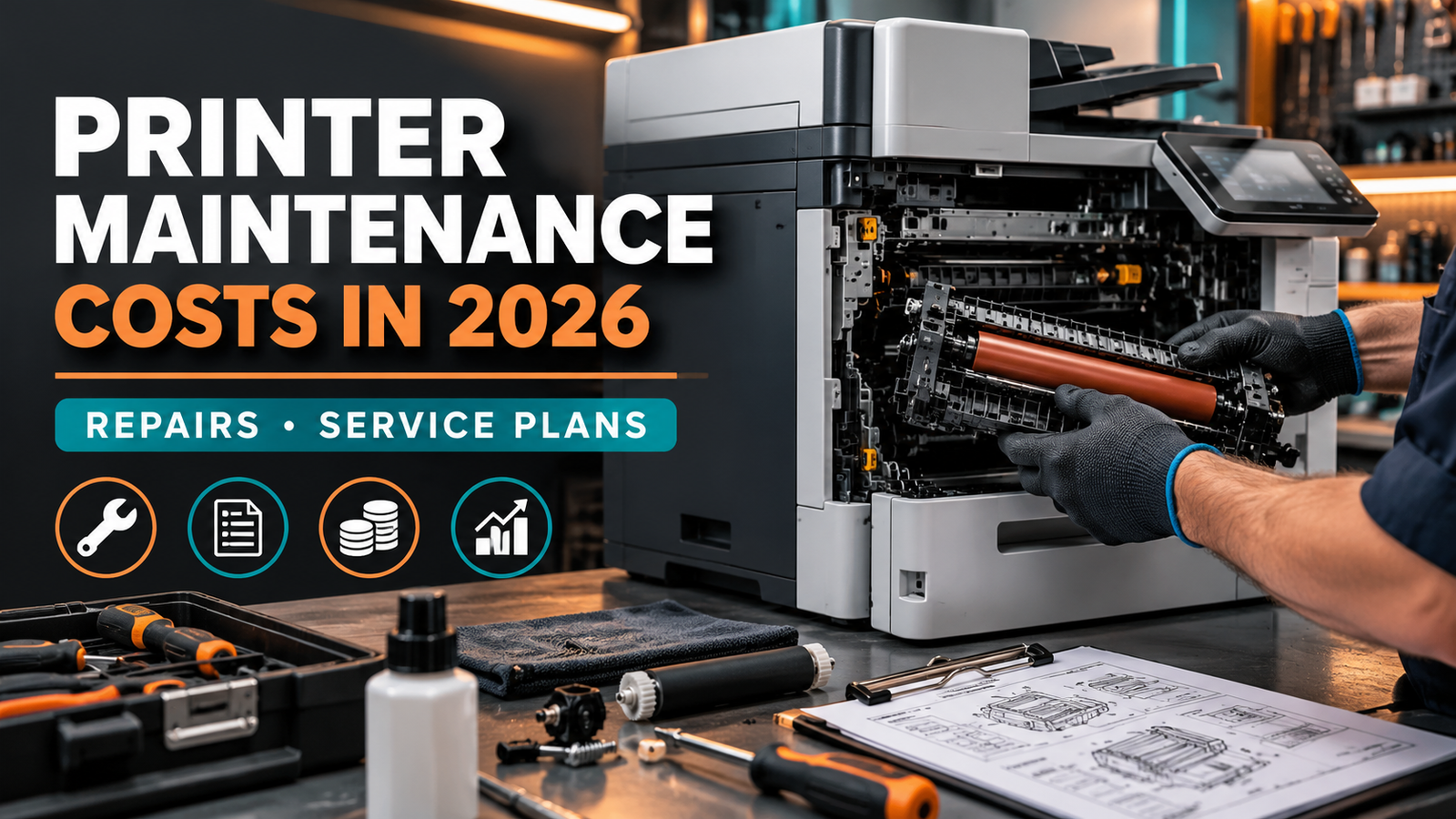
Commercial printer maintenance cost is an important expense for businesses that rely on printers, copiers, and multifunction devices every day. In 2026, even a small printing problem can lead to unexpected repair bills, employee downtime, wasted paper, and delays in completing important office tasks.
A commercial printer may work reliably for months before suddenly producing faded documents, refusing to feed paper, or displaying an unfamiliar error message. When this happens, business owners often face a difficult decision: pay for professional repairs, purchase a maintenance agreement, or replace the equipment entirely.
The correct answer depends on several factors, including the printer’s age, monthly printing volume, replacement parts, technician charges, and the importance of printing to daily operations.
For a small office printing occasional invoices, paying for individual repairs may be more economical than maintaining a monthly service contract. For a larger business printing thousands of documents every month, predictable maintenance coverage can help reduce financial uncertainty.
This guide explains commercial printer maintenance expenses in the United States, examines published 2026 repair pricing ranges, compares maintenance agreements, and provides practical examples for estimating the true cost of keeping business printing equipment running.
How Much Does Commercial Printer Maintenance Cost in 2026?
Commercial printer maintenance prices vary across the United States.
The amount a business pays depends on the type of equipment, the problem being repaired, whether the printer is under warranty, and the service company’s billing policies.
According to a 2026 planning guide published by Advanced Business Technology, printer and copier service-call or diagnostic charges commonly fall around $100 to $250, while on-site labor can range from approximately $85 to $185 per hour.
Many ordinary repairs are estimated in the $150 to $500-plus range, with major assemblies potentially costing more.
These figures are published planning estimates rather than a statistically established nationwide average.
Commercial Printer Repair Cost Comparison
| Repair or service category | Indicative US cost |
|---|---|
| Service call and diagnosis | $100–$250 |
| On-site technician labor | $85–$185 per hour |
| Standard repair | $150–$500+ |
| Major component repair | $250–$700+ |
| Full-service copier agreement | Around $75–$250 monthly |
| Paper, toner and other supplies | Depends on equipment and coverage |
Repair ranges are based on Advanced Business Technology’s 2026 guide. The monthly service-contract range reflects published August 2026 guidance from US Office Solutions. Figures are approximate and are not guaranteed quotations. Some charges may overlap, while others are billed separately.
For example, a service company may charge a single diagnostic fee that includes travel and the first portion of labor.
Another provider may charge a visit fee, hourly labor, and replacement parts separately.
Therefore, comparing only the technician’s hourly rate can be misleading.
A complete written quotation should explain every relevant charge.
What Is Commercial Printer Maintenance?
Commercial printer maintenance includes the work necessary to keep business printing equipment operating safely, reliably, and efficiently.
It may involve routine cleaning, replacing worn components, monitoring consumables, updating firmware, adjusting print settings, and repairing mechanical or electronic problems.
The maintenance requirements of a small desktop printer differ considerably from those of a large commercial multifunction copier.
A compact monochrome laser printer may have relatively few user-replaceable components.
An advanced office copier can include multiple paper trays, scanning systems, finishing accessories, imaging assemblies, transfer components, and other serviceable parts.
As equipment becomes more complex, maintenance can require specialized knowledge and tools.
Preventive Maintenance
Preventive maintenance involves inspecting and caring for equipment before a serious failure occurs.
Examples include checking paper-feed rollers, inspecting accessible paper paths, monitoring component-life indicators, updating supported firmware, and cleaning approved surfaces according to manufacturer instructions.
The purpose is to identify developing problems before they interrupt normal printing.
Corrective Maintenance
Corrective maintenance begins after something stops working correctly.
Examples include repairing repeated paper jams, replacing a failed fuser, fixing document feeder problems, or diagnosing electrical faults.
Corrective work can be more expensive when technicians must visit urgently or order specialized replacement parts.
For businesses that depend heavily on printing, both preventive and corrective maintenance should be considered when planning an annual equipment budget.
Common Commercial Printer Repairs and Their Costs
Not every printer problem requires an expensive repair.
Some issues involve simple cleaning or software configuration, while others require specialized components.
1. Paper Jam and Roller Repairs
Repeated paper jams are among the most frustrating office printing problems.
A printer may jam because of worn pickup rollers, damaged separation pads, unsuitable paper, foreign objects, or incorrectly loaded trays.
When a printer jams occasionally, users can usually follow the manufacturer’s instructions to remove paper safely.
However, a machine that repeatedly jams at the same location may need professional attention.
The total repair expense depends on the component involved and the time required for diagnosis and replacement.
For example, a worn feed roller may be relatively straightforward to replace on one printer but more difficult to access on another.
Businesses should request a diagnosis before assuming that every paper jam requires a major assembly replacement.
2. Printer Fuser Replacement
The fuser is an important component in many laser printers.
It uses heat and pressure to bond toner to paper.
When a fuser develops problems, printed documents may show loose toner, repeated marks, wrinkles, or related defects.
A malfunctioning fuser can also trigger printer error messages.
The cost depends on the printer model, compatible replacement kit, labor requirements, and availability of parts.
Major assembly repairs can fall within the broader $250 to $700-plus planning range noted earlier, although a specific fuser replacement may cost less or substantially more.
HP provides model-specific fuser replacement documentation for selected LaserJet printers, emphasizing the importance of using the correct part number and following equipment safety instructions.
Because fuser assemblies can become extremely hot and printer internals may contain hazardous electrical components, businesses should never attempt an unsupported repair.
Use approved user-replaceable components only where the manufacturer’s instructions permit it. Otherwise, consult a qualified technician.
3. Drum Unit Replacement
Laser printers commonly use imaging drums to help transfer toner onto paper.
Some printers combine toner and drum components, while others use separate replacement units.
This distinction affects long-term maintenance expenses.
For example, Brother lists the DR229CL drum unit used with its MFC-L3780CDW printer as having an approximate life of 20,000 pages under specified conditions.
The actual lifespan can vary with printing patterns and the number of pages printed per job.
When an imaging drum reaches the end of its useful life, print quality can decline or the printer may display a replacement message.
Before purchasing a new drum, confirm the exact model number and whether the existing problem is caused by the drum or another component.
Replacing the wrong part can increase maintenance expenses without solving the issue.
4. Transfer Belt and Waste-Toner Components
Color toner-based printers may use transfer belts and waste-toner containers.
These components can have different replacement intervals from ordinary toner cartridges.
Brother lists a BU229CL belt unit with an approximate 50,000-page lifespan for the MFC-L3780CDW under its specified methodology.
The same model also supports a separate waste-toner box.
Not every office will replace these parts during the same ownership period.
However, businesses planning to keep a color printer for several years should include potential replacement costs in their total ownership calculation.
5. Scanner and Automatic Document Feeder Repairs
Multifunction office printers frequently include scanners and automatic document feeders.
These components can develop problems such as paper misfeeds, crooked scans, streaks, and document detection errors.
A scanner problem does not always mean that the scanning hardware is broken.
Dust or marks on the narrow ADF scanning glass can sometimes cause repeated streaks. Cleaning the approved glass surface according to manufacturer instructions may resolve this issue.
More serious problems involving motors, sensors, or internal feeder mechanisms may require professional servicing.
Office Printer Maintenance Contract Costs
Businesses that want predictable servicing expenses may consider a printer maintenance agreement.
A maintenance contract is an arrangement under which a service company provides specified support in exchange for recurring fees or per-page charges.
Depending on the agreement, coverage may include technician visits, replacement components, preventive maintenance, and printing supplies.
A Florida-based copier service provider, US Office Solutions, published August 2026 pricing guidance indicating that full-service copier agreements for typical offices can cost approximately $75 to $250 monthly.
Its published examples also describe black-and-white click rates around 1.1 to 1.8 cents per page and color click rates around 6 to 9 cents per page.
These are one provider’s market observations, not universal national prices.
What Does a Printer Service Contract Include?
| Service | May be included? |
|---|---|
| Routine maintenance | Yes, depending on plan |
| Technician labor | Often |
| Replacement wear parts | Often in comprehensive plans |
| Toner | May be included |
| Emergency support | Depends on response agreement |
| Office printing paper | Usually excluded |
| Physical damage | Often excluded |
| Network and software support | Varies |
| Equipment relocation | Often charged separately |
The details matter more than the name of the package.
A contract described as full-service may still exclude damage, certain consumables, or specialized software problems.
Businesses should carefully examine the written coverage description before making a financial commitment.
Commercial Printer Maintenance Cost: Pay-As-You-Go vs Service Contract
Two common approaches to maintaining commercial printers are paying for individual repairs and purchasing ongoing service coverage.
Neither approach is automatically cheaper for every business.
Pay-As-You-Go Maintenance
Under a pay-as-you-go arrangement, sometimes called break-fix service, a business pays when a problem occurs.
There may be no monthly maintenance payment.
This can be attractive for smaller offices with relatively reliable printers.
However, expenses can become unpredictable.
A company may have several months without any repair costs, followed by a significant bill for a failed component.
Printer Maintenance Agreement
A maintenance agreement provides defined support under a recurring payment or usage-based contract.
This can make budgeting easier, particularly for companies with several devices or business-critical printing requirements.
Some providers also offer defined response times and preventive servicing.
The disadvantage is that the business may pay for coverage during months when no repairs are needed.
Which Option Costs Less?
Consider a fictional office producing 2,000 black-and-white impressions and 300 color impressions monthly.
The company is comparing two hypothetical service arrangements covering the same printers.
| Monthly expense | Self-managed | Service contract |
|---|---|---|
| Black printing supplies | $46 | $36 |
| Color printing supplies | $30 | $25.50 |
| Repair and maintenance reserve | $35 | Included |
| Fixed service charge | $0 | $45 |
| Estimated monthly total | $111 | $106.50 |
| Estimated annual total | $1,332 | $1,278 |
Under these assumptions, the service contract costs $54 less annually.
However, that is a relatively small difference.
If the printer rarely needs repairs, the self-managed option could become more economical.
If the machine experiences frequent breakdowns, a properly structured service contract could provide more value.
These are illustrative calculations, not actual vendor quotations. They assume comparable coverage and exclude paper, electricity, equipment financing, and taxes.
How Printer Maintenance Affects Total Cost of Ownership
The purchase price is only one component of a business printer’s financial impact.
Total cost of ownership includes equipment, consumables, maintenance, repairs, and other relevant expenses over the period of use.
A relatively inexpensive printer may become costly if it requires frequent cartridge replacements or recurring service calls.
Meanwhile, a more expensive device may offer better long-term value if it performs reliably and supports economical replacement supplies.
Three-Year Printer Ownership Example
Consider a fictional small office purchasing a business printer for $900.
The business estimates annual supplies at $420 and reserves $180 annually for maintenance.
Over three years, its estimated costs would be:
| Expense | Three-year amount |
|---|---|
| Printer purchase | $900 |
| Ink or toner | $1,260 |
| Maintenance reserve | $540 |
| Total estimated expense | $2,700 |
This estimate excludes electricity, paper, financing, and major unexpected repairs.
If the business prints 24,000 pages during those three years, the combined listed expenses amount to approximately 11.25 cents per page.
This demonstrates why purchasing equipment based solely on the lowest advertised price can lead to poor financial decisions.
For a fuller buying-cost comparison, readers can explore our related printer ownership guides at ColorPrinterTestPage.com.
Repair or Replace: When Should a Business Buy a New Printer?
One of the most important decisions in commercial printer maintenance is knowing when further repairs are no longer economical.
There is no universal repair-price percentage that works for every machine.
A $400 repair may be worthwhile on a reliable commercial copier worth several thousand dollars.
The same repair may be difficult to justify for an aging desktop printer that can be replaced for a comparable amount.
Evaluate the Printer’s Age and Condition
Older printers can continue operating reliably, but replacement parts may become harder to obtain.
A business should check whether the manufacturer still provides compatible supplies, drivers, firmware, and technical support.
Repeated mechanical failures can also suggest that several components are approaching the end of their useful lives.
Compare Repair Cost With Replacement Cost
Imagine an office receives a $350 repair quotation for a printer that could be replaced with a comparable new model for $550.
The difference is only $200.
If the old machine also requires a drum replacement and has experienced several recent failures, replacement may deserve serious consideration.
However, if the printer remains well supported and the repair would restore reliable performance, fixing it could be reasonable.
The decision should reflect expected remaining life, future maintenance needs, and the operational importance of the device.
Consider Printer Downtime
Downtime creates a cost that is frequently missing from repair quotations.
If employees cannot produce shipping labels, invoices, or customer documents, business activity may slow down.
For illustration, suppose a printer failure causes three employees to lose one productive hour each.
If their loaded labor cost is estimated at $25 per hour, the direct productivity impact could be approximately $75.
This is only an illustrative labor estimate; the actual economic impact depends on whether employees can switch tasks and how the disruption affects operations.
A business that depends on one critical printer may benefit from having a backup device or a service agreement with meaningful response commitments.
How to Reduce Commercial Printer Maintenance Expenses
Controlling printer maintenance costs does not require purchasing the most expensive equipment or signing the longest contract.
Small operational improvements can make a difference.
Choose Equipment Suitable for Your Print Volume
Manufacturers often publish a recommended monthly printing volume and a maximum duty cycle.
These two measurements should not be confused.
The recommended monthly volume is generally a better guide for selecting equipment for regular use.
Repeatedly operating a printer far beyond its recommended workload may increase the frequency of service needs.
Use Paper That Meets Manufacturer Specifications
Incorrect paper type, weight, or storage conditions can contribute to feeding problems.
Businesses should use paper compatible with their printer and keep supplies in appropriate storage conditions.
Damp, curled, or damaged paper can create unnecessary jams and waste.
Train Employees on Basic Printer Care
A small amount of employee training may reduce avoidable problems.
Staff should understand how to load paper correctly, recognize low-supply messages, remove accessible paper jams safely, and report repeated errors.
Employees should not dismantle internal components or bypass safety mechanisms.
A clearly documented procedure can reduce the likelihood of a minor problem becoming a more expensive repair.
Monitor Firmware and Software Support
Some printing problems are related to outdated drivers, network configuration, or software changes rather than mechanical failures.
Businesses should obtain updates from official manufacturer sources, evaluate compatibility, and follow appropriate IT change-control procedures.
Firmware updates should not be installed casually during critical business operations.
Track Repeated Problems
A maintenance log can provide valuable information.
Record the printer model, installation date, current page counter, error messages, replacement parts, repair costs, and dates of technician visits.
When a problem appears repeatedly, this history may help a technician diagnose its cause more efficiently.
It can also support a better repair-versus-replace decision.
Commercial Printer Maintenance Checklist
A simple inspection schedule can help businesses identify visible problems without performing risky internal repairs.
| Frequency | Suggested activity |
|---|---|
| Weekly | Check print quality and accessible paper paths |
| Monthly | Review usage counters and supply levels |
| Monthly | Inspect recurring error messages |
| Quarterly | Review maintenance history and printing costs |
| As recommended | Replace approved consumables and wear parts |
| When needed | Arrange professional servicing for recurring faults |
These are suggested administrative checks rather than manufacturer-required service intervals.
The printer’s own maintenance schedule and support documentation should take priority.
Can Printer Test Pages Help Prevent Maintenance Problems?
A printer test page can help identify deteriorating output quality before a large printing job is started.
For example, an office preparing 200 customer brochures may discover faded colors or uneven printing after producing only one sample.
Identifying the problem early can reduce wasted paper and repeated print jobs.
Printer tests are also useful after installing new cartridges, replacing certain consumables, or performing approved maintenance.
The free printing resources at ColorPrinterTestPage.com can help users evaluate color output, grayscale consistency, alignment, and other visible characteristics.
However, a test page cannot confirm that all mechanical components are healthy.
A machine may produce a good sample print and still have a worn feed roller or developing electrical problem.
Printer testing should therefore be treated as one part of routine quality monitoring, not a replacement for professional maintenance.
How to Choose a Reliable Commercial Printer Repair Service
Choosing the correct repair company can be just as important as selecting the equipment.
Before scheduling service, confirm whether the provider supports your exact printer model.
Ask whether technicians are trained for that equipment and whether original or manufacturer-approved parts are available.
Request details about diagnostic charges, labor rates, travel expenses, and estimated repair time.
Businesses should also ask about warranties on replacement parts and technician labor.
For critical office printers, response time matters.
A low-cost provider that cannot arrange a technician for several days may be less attractive than a provider offering reliable support within a defined period.
It can also be useful to request multiple quotations for an expensive repair.
The lowest price should not automatically determine the choice. Coverage, reliability, qualifications, and total costs are important considerations.
Commercial Printer Maintenance Contracts: Questions Before Signing
A maintenance agreement can simplify operations, but contract terms should be reviewed carefully.
Businesses should understand whether the monthly payment covers equipment, service, consumables, or a combination of those items.
Ask whether color and black-and-white pages have different prices.
Confirm minimum monthly charges, price increase provisions, service coverage boundaries, and contract renewal requirements.
Also clarify whether the provider charges separately for emergency technician visits or replacement equipment.
A company operating several printers should request a consistent written comparison of all eligible devices.
This makes it easier to evaluate competing providers and avoid unexpected expenses later.
Frequently Asked Questions About Commercial Printer Maintenance
How much does commercial printer maintenance cost in 2026?
Published U.S. planning estimates show diagnostic visits around $100 to $250, on-site labor approximately $85 to $185 per hour, and many ordinary repairs around $150 to $500 or more. Actual costs depend on equipment, location, and the specific repair.
Is a printer maintenance contract worth it?
A maintenance contract may be valuable for businesses with frequent printing, multiple machines, or costly downtime. Small offices with reliable, lightly used printers may spend less by purchasing supplies and paying for repairs when necessary.
How much does it cost to replace a printer fuser?
Fuser replacement expenses vary considerably by printer model, replacement kit, and labor requirements. Major component repairs may cost several hundred dollars or more. Request a model-specific written quotation before approving the repair.
How often should a commercial printer be serviced?
Service intervals depend on the manufacturer’s recommendations, actual usage, environmental conditions, and equipment type. Some businesses need only regular checks, while high-volume commercial systems may require scheduled professional maintenance.
Are toner cartridges included in maintenance contracts?
Some comprehensive copier service agreements include toner. Others charge for supplies separately. The contract should specify the exact consumables and replacement parts included.
Should I repair or replace an old printer?
Compare the repair quotation with the cost of suitable replacement equipment. Consider printer age, parts availability, recent failures, security support, and expected future expenses.
Can printer cleaning reduce repair costs?
Appropriate cleaning can help prevent some print-quality and paper-handling problems. However, cleaning should follow manufacturer instructions, and it cannot correct every mechanical or electronic failure.
Does printer maintenance affect print quality?
Yes. Worn drums, contaminated scanning surfaces, damaged rollers, and other component problems can affect printed or scanned documents. Regular checks can help detect these issues earlier.
Final Thoughts
Commercial printer maintenance cost in 2026 depends on far more than the price of a technician visit.
Businesses must consider equipment reliability, replacement supplies, repair parts, service agreements, monthly print volume, and the financial impact of printer downtime.
Small offices may find that maintaining a reliable printer and paying for occasional repairs offers good value.
Larger companies may benefit from maintenance agreements or managed print services that combine technical support, consumables, and predictable operating expenses.
However, the most expensive service contract is not automatically the best option, and the cheapest repair quotation may not provide the most reliable solution.
Before making a decision, review maintenance history, compare written quotations, and calculate the complete cost of operating the printer over several years.
With appropriate equipment, careful planning, and regular quality checks, businesses can reduce avoidable printing expenses and support more reliable daily operations.
Sources and References
The following resources were used to research U.S. repair pricing, maintenance contract structures, and equipment components.
- Advanced Business Technology — Printer and Copier Repair Cost Guide (2026) — U.S. repair pricing ranges and service billing practices.
- US Office Solutions — Copier Service Contracts and Costs — Published August 27, 2026, with examples of monthly contracts and cost-per-page pricing.
- Brother MFC-L3780CDW — Official Consumables and Accessories — Drum, belt, toner and waste-toner components.
- HP LaserJet Fuser Replacement — Official Support — Model-specific repair guidance and safety procedures.
- HP LaserJet Fuser and Maintenance Kit Messages — Official maintenance indicators and replacement recommendations.
Editorial note: Pricing information reflects published U.S. sources reviewed in October 2026. Repair prices are planning ranges, not guaranteed quotations. Financial examples are hypothetical and should not be interpreted as actual offers. This article provides general information and does not replace manufacturer maintenance instructions or qualified technical advice.