
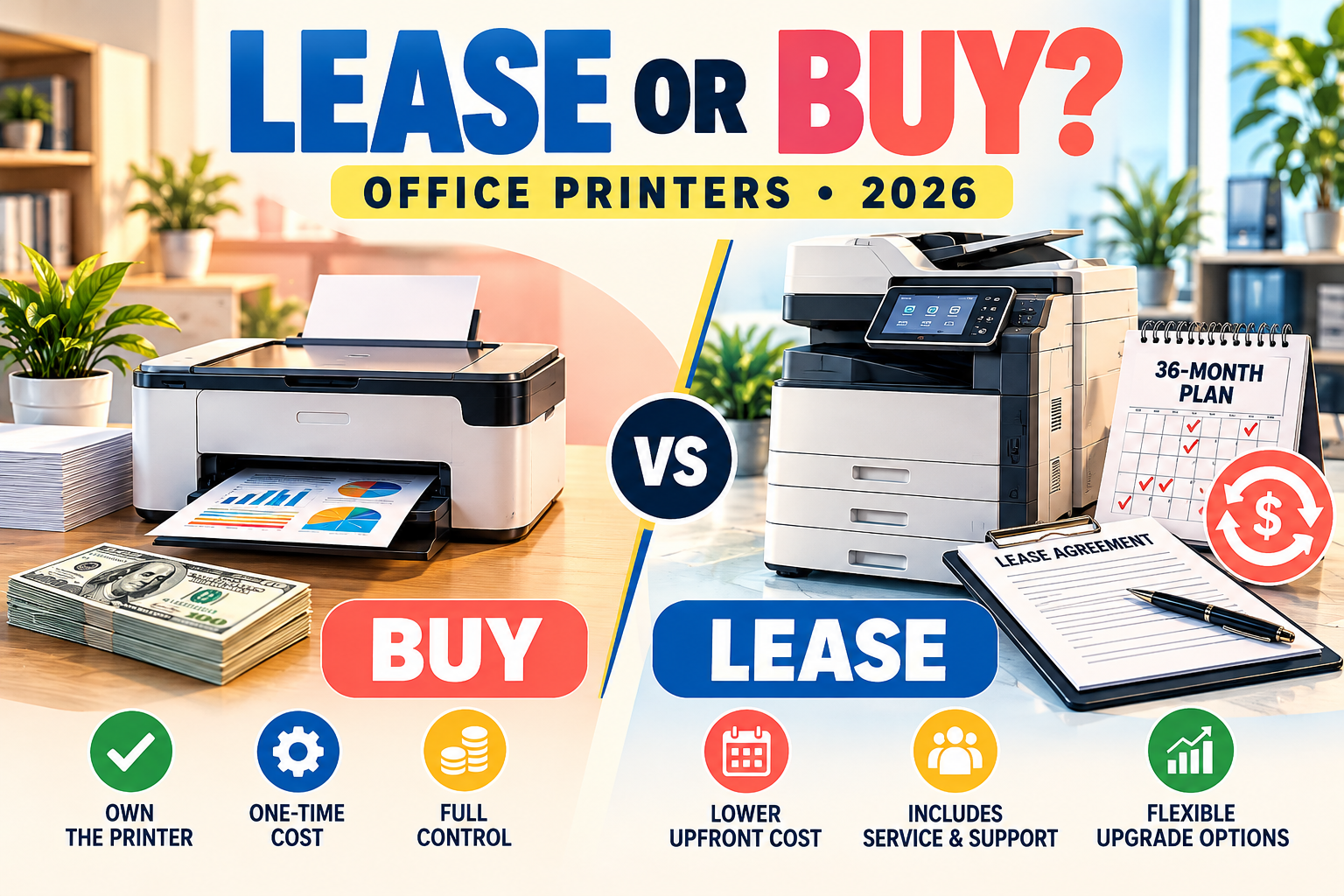
Printer leasing vs buying is an important financial decision for small businesses in 2026. Choosing the right option can help business owners reduce printing expenses, manage monthly budgets, and avoid unexpected equipment costs. Whether you run a small office or a growing company, understanding printer lease prices, ownership costs, maintenance fees, and contract terms can help you make a smarter investment.
The answer is not always simple. Buying an office printer gives a business ownership and more control over long-term expenses. Leasing allows a company to use equipment while spreading payments over several months or years. Some leasing arrangements also provide maintenance, technical support, and toner replacement through a separate or bundled service agreement.
In 2026, office printer leasing remains an option for American businesses that need commercial printing equipment without making a large upfront investment. But affordable monthly payments do not automatically mean a better deal. Contract conditions, service fees, printing allowances, and equipment return requirements can make leasing more expensive than expected.
This guide compares printer leasing versus buying, explains typical U.S. office copier lease prices, examines common contract charges, and provides practical examples to help business owners estimate their total printing expenses.
What Is Printer Leasing and How Does It Work?
Printer leasing is an arrangement in which a business pays to use printing equipment for an agreed period instead of purchasing it immediately.
A typical commercial printer lease may last 36, 48, or 60 months. During that period, the business makes regular payments under its equipment agreement. Depending on the contract, the company may return the printer, renew the arrangement, upgrade equipment, or purchase the machine when the lease ends.
Office printer leasing is particularly common when businesses need multifunction copiers capable of handling large document volumes, automatic scanning, secure printing, and advanced paper management.
For example, a small accounting company might need a commercial multifunction printer that costs several thousand dollars. Rather than purchasing the equipment immediately, the owner may choose a multi-year leasing agreement.
This allows the business to preserve cash for other expenses, such as employee salaries, software subscriptions, and office operations.
However, leasing companies and equipment dealers sometimes operate under separate agreements. The business may pay one company for equipment financing and another for maintenance or printing services.
Understanding this distinction is essential because a printer lease does not always include unlimited printing, replacement toner, or free repairs.
How Much Does It Cost to Lease an Office Printer in 2026?
Office printer leasing prices vary considerably across the United States. Equipment size, printing speed, color capabilities, contract length, service coverage, and monthly page volume all affect the final price.
Published 2026 equipment-leasing guides from Advanced Business Technology and office equipment providers describe payment ranges extending from around $50 per month for certain entry-level business machines to $500 or more for advanced office equipment.
Larger commercial and production systems can cost significantly more.
Estimated Monthly Printer Leasing Prices
| Printer category | Indicative monthly lease | Typical business need |
|---|---|---|
| Compact office multifunction printer | $50–$150 | Small offices and basic document handling |
| Mid-range business copier | $150–$350 | Growing offices and shared printing |
| Advanced color multifunction copier | $200–$500 | Higher-volume business documents |
| High-volume commercial copier | $500–$900+ | Large departments and production workloads |
These are broad market planning ranges based on published 2026 provider guides, not national statistical averages or guaranteed quotations. Individual offers may differ significantly. Service charges, supplies, taxes, installation, and paper may be additional.
A low monthly price can make leasing attractive, but comparing equipment payments alone can produce misleading conclusions.
A $120 monthly equipment lease with separately billed toner and maintenance could cost more than a $180 package that includes suitable service coverage.
Business owners should request an itemized quotation showing exactly what is included.
Printer Leasing vs Buying: Main Differences
Leasing and buying serve different financial and operational needs. Neither method is automatically the best option for every business.
Buying usually involves a larger initial payment but gives the owner greater flexibility. Leasing spreads equipment costs over time while creating a contractual commitment that may continue even if business requirements change.
| Feature | Leasing | Buying |
|---|---|---|
| Initial payment | Often lower | Full purchase price or financed purchase |
| Equipment ownership | Depends on lease structure | Business owns the printer |
| Monthly commitment | Usually required | Not required after cash purchase |
| Maintenance | Separate or sometimes bundled | Purchased separately or covered by warranty |
| Upgrade flexibility | Depends on contract | Owner can replace or sell equipment |
| Early cancellation | May be expensive | No lease cancellation charge |
| End-of-term obligation | Return, renew, or purchase | Keep, sell, or recycle |
| Long-term cost | Includes financing and possible fees | Includes purchase, supplies, and upkeep |
The difference becomes especially important when a business plans to keep its equipment for several years.
A small company purchasing an affordable printer and using it for five years may spend less on equipment than a similar company making monthly lease payments throughout that period.
On the other hand, an organization that relies on a sophisticated copier and needs dependable service may value a well-structured lease arrangement.
Buying an Office Printer: What Are the Real Costs?
Buying provides ownership from the beginning. Once the purchase is completed, the business can use the printer without making equipment lease payments.
The owner is responsible for normal operating expenses, including replacement ink or toner, paper, electricity, maintenance, and potential repairs.
For smaller offices, the purchase price may be manageable. Compact monochrome laser printers and multifunction inkjet machines generally require a much smaller investment than commercial floor-standing copiers.
However, the cost increases when businesses need faster printing, advanced document feeders, additional paper trays, finishing options, or high-volume printing capacity.
Example: Buying a Printer for a Small Office
Consider a fictional consulting business that purchases an office printer for $450.
The company expects to keep it for three years and estimates average printing supplies at $22 per month. It also reserves $6 per month for possible maintenance expenses.
| Expense | Three-year estimate |
|---|---|
| Printer purchase | $450 |
| Printing supplies | $792 |
| Maintenance reserve | $216 |
| Total estimated cost | $1,458 |
This estimate excludes paper, electricity, taxes, and unexpected equipment replacement.
If the business had instead signed a hypothetical agreement charging $65 per month for equipment and another $24 for service, its three-year contractual payments would total $3,204.
Under these particular assumptions, buying costs $1,746 less.
This example does not demonstrate that purchasing always wins. The two arrangements may cover different service benefits, replacement risks, and printer capabilities. It illustrates why the entire cost should be calculated before making a decision.
Leasing an Office Printer: Advantages and Disadvantages
Leasing can be practical for a business that needs expensive equipment but wants to avoid a large initial payment.
A growing company may prefer to keep its available cash for staffing, advertising, inventory, or other operating expenses.
Leasing can also create more predictable equipment payments when the agreement specifies fixed rates. Some providers offer maintenance packages that make repair support and replacement supplies easier to manage.
For businesses with several employees and frequent printing needs, convenient access to equipment service can be particularly valuable.
However, leasing creates obligations that are often difficult or expensive to terminate early.
A company that signs a five-year contract may still owe substantial payments if it closes an office, downsizes, or no longer needs the original equipment.
Another disadvantage is that an equipment lease may not result in ownership. A business could make payments for several years and still be required to return the machine at the end of the term.
The key is to compare the full agreement rather than focusing only on an attractive monthly price.
Understanding Printer Lease Contracts
One of the most important parts of choosing a printer lease is understanding what happens when the contract ends.
Two commonly discussed commercial copier financing structures are fair market value leases and $1 buyout leases.
Fair Market Value (FMV) Lease
A fair market value lease generally offers the ability to use equipment during the agreement and return it, renew the arrangement, or purchase it at an agreed method of determining fair market value when the term ends.
This structure may offer a lower monthly payment than a comparable $1 buyout arrangement.
It can make sense for organizations that expect to replace their equipment periodically.
However, the end-of-term purchase price is not necessarily fixed in advance. A business that wants to keep the equipment should ask how the value will be determined.
$1 Buyout Lease
A $1 buyout lease is structured so that the customer can obtain ownership at the end by making the specified nominal purchase payment, commonly one dollar.
The monthly payments may be higher because the agreement is designed to transfer substantially more of the equipment’s value over the lease term.
This type of financing may interest businesses that want to keep equipment for several years after the contract expires.
Before signing, compare the total payments, financing cost, service coverage, applicable taxes, and end-of-term conditions.
Hidden Printer Leasing Fees Businesses Should Understand
Hidden or poorly understood charges are among the biggest reasons a copier lease can become more expensive than the original quotation suggests.
1. Cost-Per-Copy and Overage Charges
Commercial printer service agreements may charge a fee for each page printed, commonly called a click charge.
Black-and-white printing often carries a lower per-page rate than color printing.
For example, Printree’s published September 2026 leasing information lists specific overage rates of $0.01 per black-and-white page and $0.07 per color page under certain packages.
Those amounts are examples of one provider’s published pricing, not universal industry rates.
Suppose a business exceeds its monthly allowance by 1,200 black-and-white pages and 150 color pages.
| Additional printing | Charge |
|---|---|
| 1,200 black pages at $0.01 | $12.00 |
| 150 color pages at $0.07 | $10.50 |
| Total additional charge | $22.50 |
The additional amount may appear small, but consistently exceeding an allowance can create meaningful annual expenses.
A business should review its actual monthly printing history before agreeing to a page allowance.
2. Annual Price Increases
Some copier service and leasing agreements allow periodic increases in charges. These clauses are sometimes called escalation provisions.
The precise amount and which part of the agreement can increase depend on the contract.
Consider a hypothetical $250 monthly charge that increases by 7% each year.
The first year costs $3,000. The second year rises to $3,210, and the third year reaches $3,434.70.
Across three years, the business pays $9,644.70 instead of $9,000 under a fixed-price arrangement.
This difference of $644.70 demonstrates why an annual increase deserves attention even when the starting monthly payment appears reasonable.
3. Delivery and Installation
Commercial copiers may require professional delivery, network configuration, software installation, and employee training.
Some providers include these services. Others bill them separately.
A detailed written quotation should clarify whether installation and initial setup are covered.
4. Early Termination Charges
Many equipment leases are difficult to cancel before their scheduled end date.
A business may be required to pay remaining installments or other amounts defined by the agreement.
This can create a major financial problem if the company relocates, reduces staff, or changes its printing requirements.
Always ask for the early termination formula in writing.
5. Equipment Return and End-of-Lease Costs
Returning a leased printer may involve packaging, transportation, condition requirements, and potential return-related charges.
Some contracts also include automatic renewal provisions or require notice within a specified period.
Owners should record the contract expiration date and notice deadline when the agreement is signed.
When Does Printer Leasing Make Financial Sense?
Leasing can be reasonable when a company needs advanced printing equipment but prefers to avoid a large cash purchase.
Imagine a busy office that prints 6,000 black-and-white pages and 500 color pages every month.
The business needs reliable document scanning, several paper trays, and convenient access to technical support.
For an illustrative four-year comparison, assume purchasing a suitable commercial printer costs $4,500 and operating supplies plus service average $160 per month.
The estimated four-year ownership expense would be $12,180, excluding paper, electricity, taxes, and residual equipment value.
Now assume a comparable leasing arrangement costs $135 per month for equipment and $150 per month for a service package that covers the same expected work.
Over 48 months, total payments would be $13,680.
In this example, the leasing option costs $1,500 more, before considering any extra fees or differences in coverage.
However, the company would preserve the initial $4,500 that purchasing requires. It may also receive valuable service commitments under its agreement.
Whether that trade-off is worthwhile depends on the company’s cash flow, repair risks, and expectations for future equipment needs.
These amounts are hypothetical financial examples, not actual provider quotations.
Managed Print Services vs Traditional Printer Leasing
Businesses comparing office printer leasing companies may also encounter managed print services, commonly abbreviated as MPS.
Managed print services typically combine equipment management with selected operational services, such as monitoring printing activity, maintaining devices, tracking supplies, and providing technical assistance.
The service may cover equipment that a business already owns, leased devices, or a combination of both.
This is different from a basic equipment lease, which may provide only the financing arrangement.
For companies managing several printers across multiple departments, an MPS arrangement can simplify support and improve visibility into print volumes.
However, managed print services also require careful evaluation.
Businesses should ask what reporting is available, how service response times are defined, whether supplies are included, and how the agreement handles excess pages.
An attractive monthly package is useful only when it fits the actual workload.
Does Leasing a Printer Save Money on Taxes?
Taxes are another consideration for U.S. business owners comparing leasing and buying.
The Internal Revenue Service explains that the federal tax treatment of equipment payments depends on whether an agreement is genuinely a lease or is treated as a conditional sale.
Payments under a qualifying business lease may be deductible as rent, while purchased equipment generally follows applicable rules for recovering its cost.
The distinction is important because a contract described as a lease by a salesperson is not automatically treated as a rental agreement for tax purposes.
Business owners should consult a qualified tax professional before relying on potential deductions.
Tax benefits can affect the overall financial comparison, but they should not replace careful evaluation of equipment costs and contract conditions.
Questions to Ask Before Signing a Printer Lease
A practical way to avoid expensive surprises is to request complete written proposals from more than one office equipment provider.
Each quotation should clearly identify the printer model, equipment payment, agreement length, service costs, expected page allowance, and additional-page charges.
Businesses should also ask whether toner, replacement parts, technician visits, software support, delivery, and installation are included.
The contract should explain whether prices can increase, how to cancel or renew service, and what happens when the equipment is returned.
Another useful question concerns the provider’s response time when a machine stops working.
For a business that prints customer documents every day, a low-cost agreement may offer poor value if technical support is slow or unreliable.
Comparing at least three detailed quotations using the same printing requirements can make differences easier to identify.
Printer Security and Data Protection Considerations
Commercial printers increasingly function as connected office devices rather than simple machines that place ink or toner on paper.
Many multifunction printers can scan documents, send files over a network, authenticate users, and store certain job information.
Businesses handling financial statements, customer records, or employee documents should examine the printer’s security capabilities.
Important considerations include administrative access controls, firmware support, secure communication settings, and available procedures for deleting stored information.
Before returning a leased printer or disposing of a purchased one, a company should follow the manufacturer’s instructions for clearing stored documents, address books, and configuration data.
The equipment provider should also explain its data-handling and disposal procedures.
These checks help reduce the risk of confidential information remaining on devices that leave the office.
How Printer Testing Can Reduce Business Printing Waste
Printer costs do not stop at equipment and supplies. Poor printing quality can also increase expenses through discarded paper, wasted toner, and repeated print jobs.
An office printing a large batch of brochures may discover color banding, alignment problems, or faded text only after dozens of pages have already been produced.
Running a test page before a large printing job can help identify these issues earlier.
Businesses can use the Color Printer Test Page website to access printing tests and check document output before committing to larger jobs.
For inkjet equipment, checking nozzle patterns may reveal blocked or missing colors. For laser printers, a grayscale or text test can help reveal uneven toner density.
Testing is useful whether the business owns or leases its equipment. However, serious mechanical or printhead problems may require professional service.
Should a Small Business Lease or Buy a Printer in 2026?
The correct choice depends primarily on printing volume, equipment requirements, available cash, and how long the company expects to use the machine.
For a freelancer or very small office printing a few hundred pages monthly, purchasing a suitable printer is often worth considering first.
These businesses may not need commercial copier features or a multi-year contractual commitment.
A growing company that prints several thousand pages each month may benefit from comparing purchase options with fully priced leasing packages.
Larger organizations with multiple departments may place additional value on maintenance agreements, technical support, security controls, and predictable equipment replacement schedules.
A business should also consider its ability to handle unexpected repair expenses.
Buying provides ownership, but the owner remains responsible for equipment problems outside warranty or service coverage. Leasing may transfer some support responsibilities under a properly structured contract, although this should never be assumed without checking the terms.
Ultimately, businesses should make the decision using projected total cost rather than the lowest advertised monthly payment.
Frequently Asked Questions About Printer Leasing vs Buying
Is it cheaper to lease or buy an office printer?
Buying can be cheaper over several years when a business purchases reliable equipment, uses it for a long period, and avoids major repairs. Leasing may provide advantages through lower upfront costs and service arrangements. Compare the total purchase expenses with every required lease payment and associated service charge.
What is the average printer leasing cost in 2026?
Published U.S. provider guides indicate that office printer equipment leases can start around $50 per month and exceed $500 for advanced machines. Higher-volume commercial systems may cost considerably more. There is no single reliable price for every business because hardware specifications and service coverage vary.
Can I lease a printer for only one year?
Some providers may offer short-term rental arrangements, but traditional commercial equipment leasing frequently involves longer commitments, such as 36 to 60 months. Businesses needing temporary printing equipment should compare rentals with standard leases.
Does a printer lease include ink and toner?
Not necessarily. Some providers bundle consumables into a monthly service package or page-based charge. Other agreements bill supplies separately. Always request written confirmation of what is covered.
What happens when a printer lease ends?
Depending on the agreement, the business may return the equipment, renew the contract, purchase the machine, or arrange a replacement. End-of-term obligations should be reviewed before signing the original lease.
Is printer leasing a good idea for a new business?
Leasing may help a new business preserve cash when it needs expensive commercial equipment. However, a startup with limited printing needs may be better served by purchasing an affordable printer and avoiding a long-term payment obligation.
Can a business upgrade a leased printer early?
Some providers offer upgrade arrangements, but early replacement can involve new financing, remaining payment obligations, or contract modifications. Businesses should not assume upgrades are free.
Final Thoughts
Choosing between printer leasing and buying in 2026 requires more than comparing a monthly payment with a purchase price.
Buying gives businesses direct ownership and can reduce long-term equipment expenses when the printer remains useful for several years.
Leasing can make advanced office printing equipment more accessible and may provide valuable support when service coverage is clearly defined.
Before making a decision, estimate monthly printing volume, review supply expenses, compare service packages, and calculate the total cost over the full contract period.
For small businesses, the best printer agreement is one that supports productivity, fits the budget, and avoids unnecessary financial commitments.
Research Sources and Pricing References
The following resources were used to research the pricing ranges, lease structures, contract considerations, and tax information in this guide:
- Advanced Business Technology — 2026 Business Printer and Copier Leasing Costs
- Printree — 2026 Copier Leasing Prices and Overage Examples
- Xerox Northeast — FMV vs $1 Buyout Leasing
- US Office Solutions — Copier Lease Agreement Terms
- Internal Revenue Service — Business Equipment Leasing Tax Guidance
Editorial note: Pricing information reflects published U.S. provider information available in October 2026. Actual equipment quotations, contract fees, tax treatment, and service inclusions vary. Numerical business scenarios are illustrative and should not be mistaken for real customer quotations.
1 comment / Add your comment below